

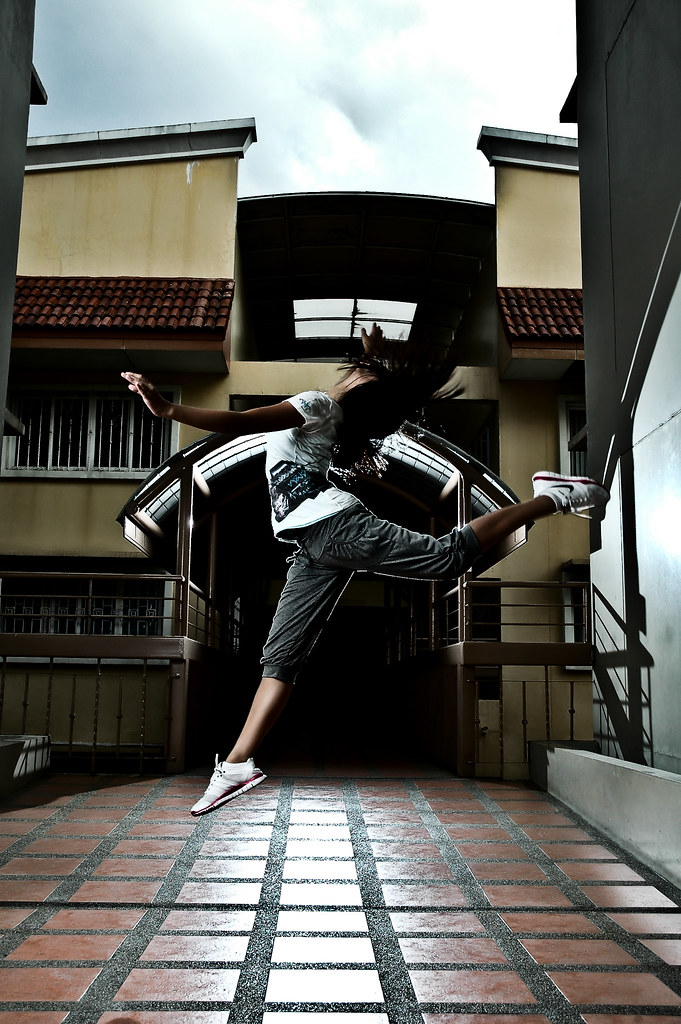
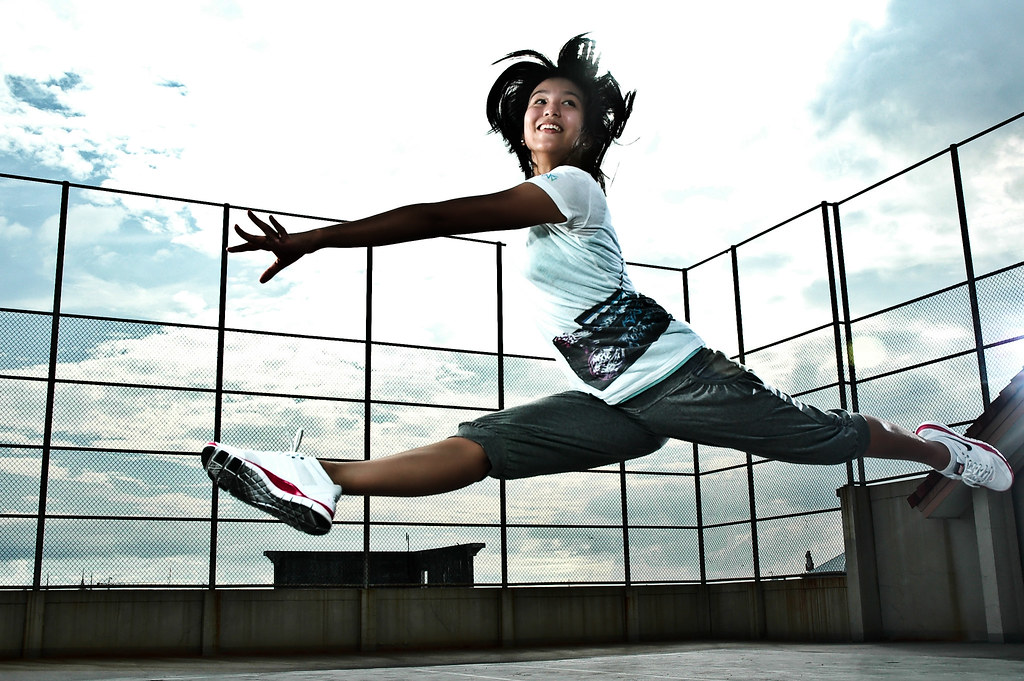
I had the chance to photograph the beautiful Aly this weekend. She's a co-worker now but was a cheerleader back in college. I asked her to do some gymnast-like jumps for me. She had some reservations, as she was one of those shy-types but after a few shots, she loosened up and started having fun with it.

As with my concept shoot a few weeks back, I started planning a few days before the shoot. The plan was have Aly do her jumps and light her from the sides and one soft light upfront. I think I was able to get as many ideas I got on the actual shoot.Unfortunately, I inadvertently threw it away with the other garbage i my pocket, so I can't show you how I visualized it. :(
update: here's how the set-up looked like for most of the shots:

update: here's how the set-up looked like for most of the shots:

Sketching what I think the final photo will look like and how I would light it really helps out the process. For example the top most image took only one shot (I was very lucky). This also saved Aly from doing multiple jumps, which saves her some energy for the next shot. She was surprised that she could stretch like this, as she never saw herself stretching that much before. Here are some more shots:


About the Title
Except for the up most shot, Aly did need to take multiple jumps for the shots. As much as I would like to get it with one frame, it would be very difficult to time each jump and get what you want. So what did I do? I shot it hi-speed and did multiple clicks (burst mode) in each jump. The flash trigger I used was a YN-04II, and my camera having an electronic shutter (D70) I was able to use a fast sync speed than most (some camera's only have a 1/250 sync speed). The shots above were in the speed range of 1/500 to 1/1000 with the flash units on 1/4 power. Having that speed enabled me to maximize the 3 frame per second limit on my camera.
Also, my camera's shutter is about 43,500 and counting, really close to the manufacturer's claim of 50,000. To those who don't know, a DSLR life ends when it reaches the maximum number of shutter clicks (or on how many times you click that shutter to take a picture). After that you would need to have your camera serviced and replace the shutter mechanism. It's not cheap, mind you. It could be just a manufacturer's claim so they'll get more profit from repairs. I kinda hope mine wouldn't die on me after 50,000 clicks, as I have a friend who has a camera that has more that 100,000 clicks and it's still working. Then again, I have another colleague who's D40 died on him at 50,000 clicks. So who knows?


